American Mathematics in the Revolutionary Era
By the last quarter of the eighteenth century, notable progress had been made in establishing cultural institutions supportive of mathematics on American shores. Institutions of higher education, supplemented by learned societies and their publications, helped to establish a certain level of mathematical competence. Still, not all mathematical adepts in the Revolutionary Era received formal training. Some like Pennsylvania’s David Rittenhouse and Maryland’s Benjamin Banneker, the latter a free African-American noted for his almanacs, were self-taught.
The colleges, among them Harvard in Cambridge, Massachusetts, the College of Philadelphia (now the University of Pennsylvania) founded by Benjamin Franklin, and William and Mary in Williamsburg, Virginia, all included mathematics (and often some mathematical astronomy) in their curricula. This was fundamental to the training of such Revolutionary-Era leaders as Thomas Jefferson and John Adams. The learned societies, specifically the American Philosophical Society (APS) founded—also by Franklin—in Philadelphia in 1743 and the American Academy of Arts and Sciences started in Boston by Adams and others in 1780, served to diffuse new mathematical and other scientific ideas. Their publications, in addition to others, diffused that new knowledge more widely.
While mathematics can hardly be said to have thrived in Revolutionary-Era America even in light of these key developments, there were notable contributions. In Massachusetts, John Winthrop IV, the second Hollis Professor of “Mathematicks and Natural Philosophy” at Harvard, distinguished himself by mastering Isaac Newton’s Philosophiæ Naturalis Principia Mathematica (Mathematical Principles of Natural Philosophy) of 1687, the notoriously difficult treatise that provided a mathematical underpinning for both terrestrial and celestial physics. He not only used that foundation in his astronomical work but also incorporated Newton’s revolutionary ideas on fluxions (what we would call calculus today) into his mathematics classroom. This made him the first person in the colonies to raise mathematical education to that level. In Virginia, Thomas Jefferson, a major landowner and so “farmer” by profession, cultivated and published mathematical ideas on topics as diverse as surveying, the compilation of almanacs, and spherical triangles. When he could, he joined Benjamin Franklin and David Rittenhouse in Philadelphia at meetings of the APS. There and elsewhere, Franklin and Rittenhouse in particular shared mathematical ideas, both frivolous and entertaining like Franklin’s magic squares as well as practical and technically useful like Rittenhouse’s almanac and his computational work on logarithms.
Benjamin Franklin (1706–1790) embraced mathematics in a playful yet ingenious way. His magic squares featured two defining characteristics. Not only did the rows and columns add up to the same sum, but so did various broken diagonals and symmetrically arranged subsets. This work blended recreation and philosophical exercise, showing how numerical harmony could mirror rational order in nature. The wide circulation of his magic squares represented a small but distinctive contribution to colonial mathematics.
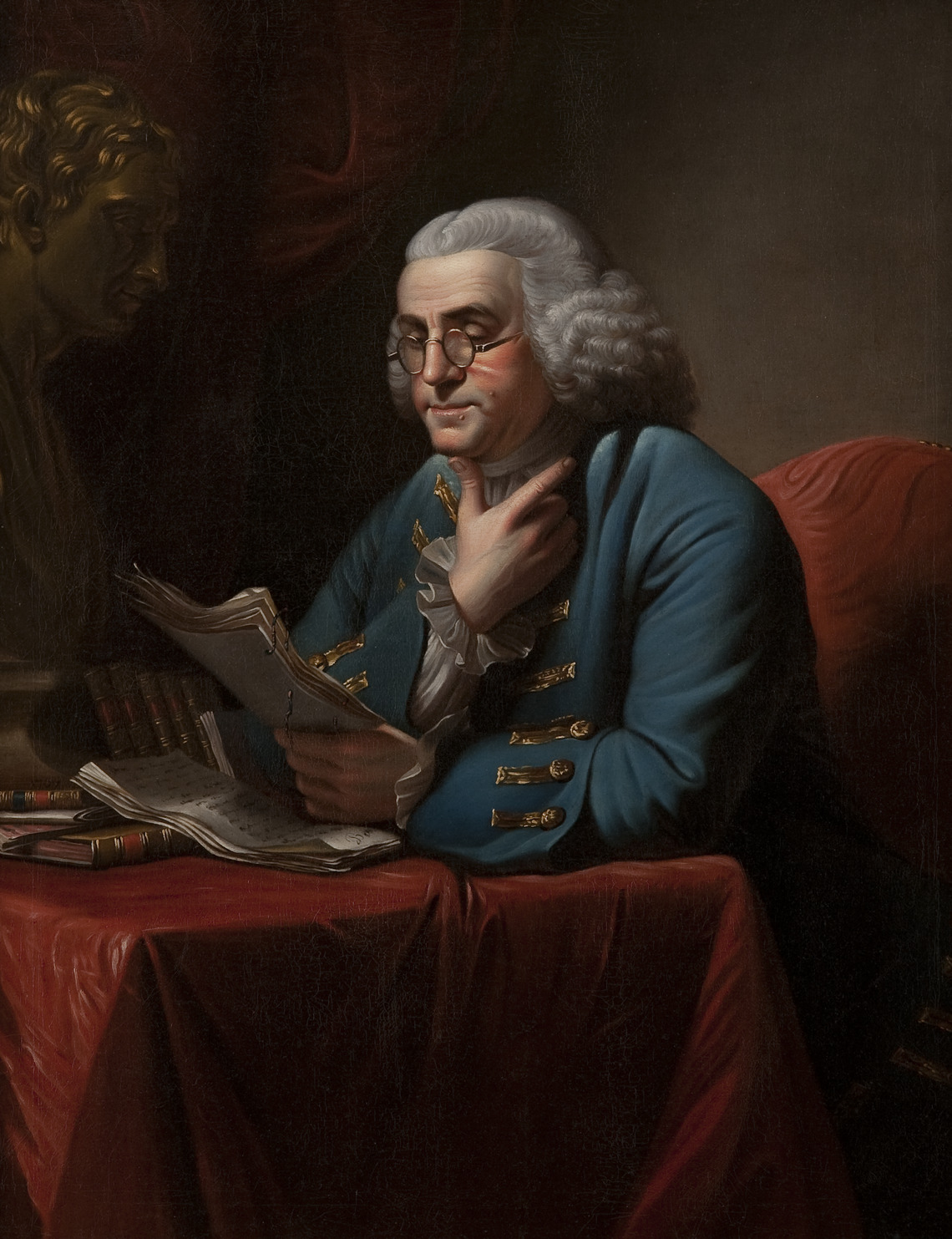
Benjamin Franklin, portrayed in a Charles Willson Peale copy of a portrait by Scottish artist David Martin (1772).
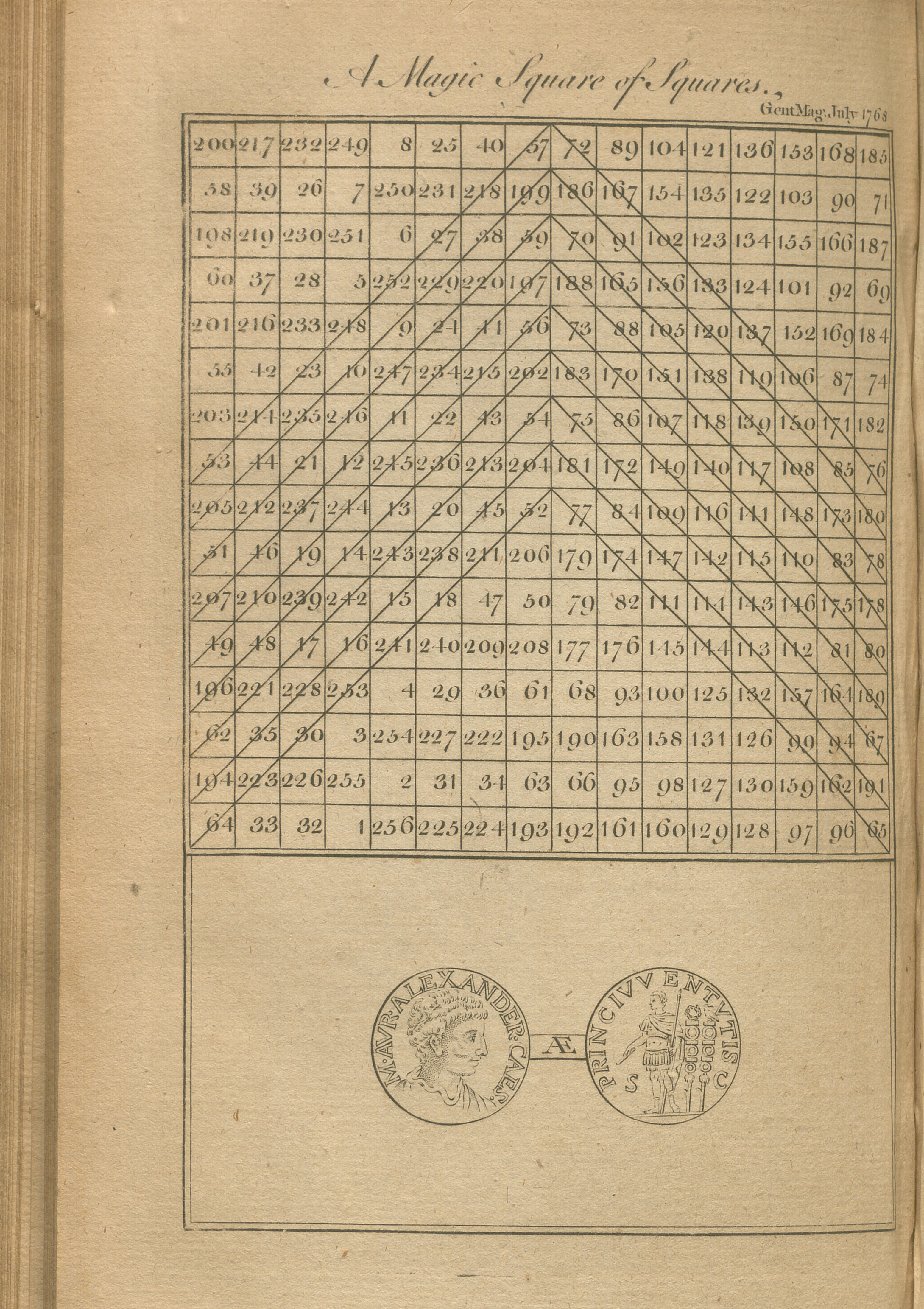
Two examples of Franklin’s magic squares, both published in The Gentleman’s Magazine and Historical Chronicle, 38 (1768), pp. 312 and 313, resp.
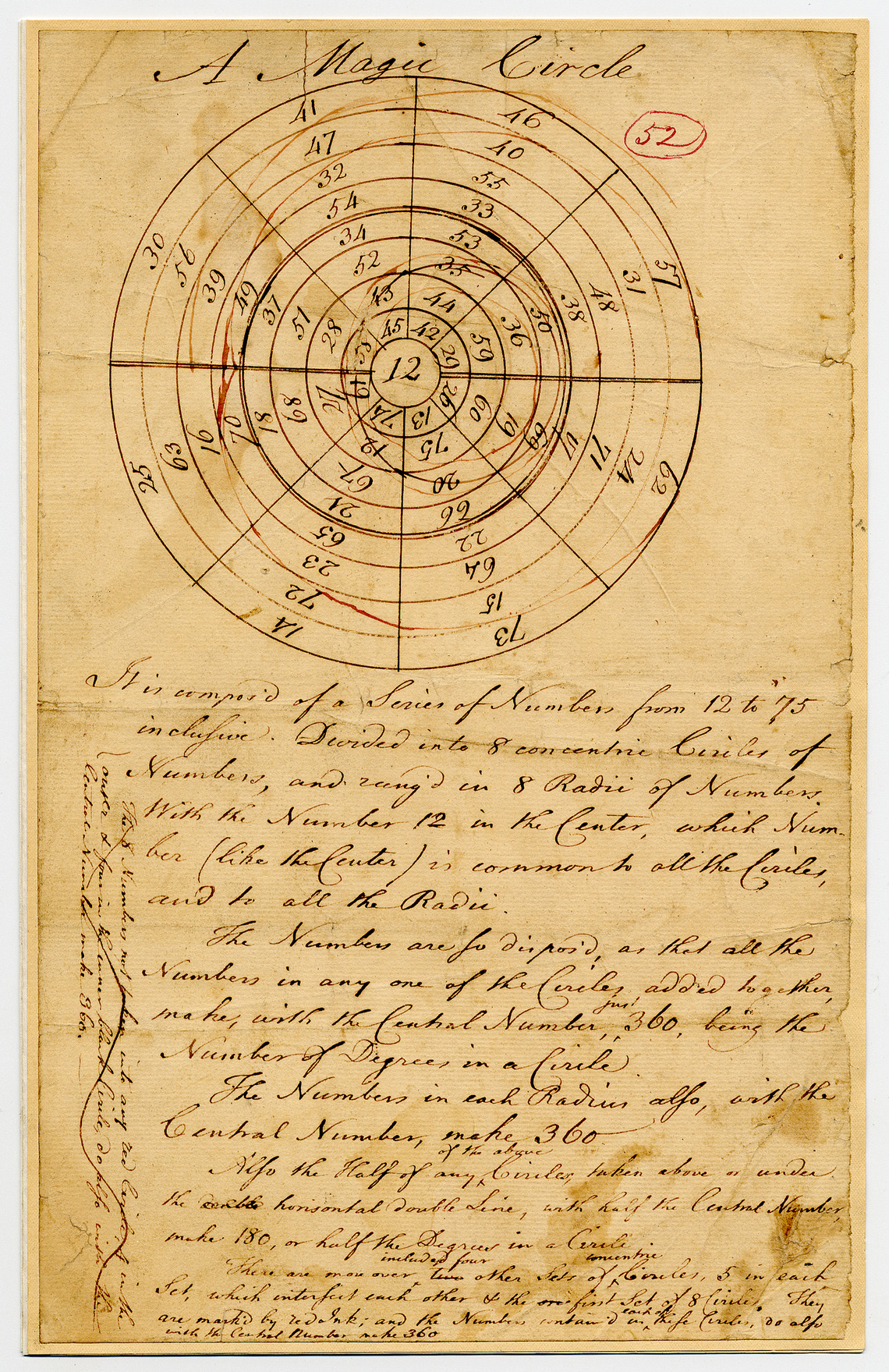
A manuscript drawing and description of a circularly arranged magic square. From the Franklin Papers, Box 96.

A fragment of a letter [1752] from Franklin to English botanist, Peter Collinson, describing a circular magic square. From the Franklin Papers, Box 96.
Further reading:
- Isaacson, Walter. Benjamin Franklin: An American Life. New York: Simon & Schuster, 2003.
- Pasles, Paul. Benjamin Franklin’s Numbers. Princeton: Princeton University Press, 2008.
David Rittenhouse (1732–1796), by contrast, used mathematics fundamentally in his work. A self-taught Philadelphia clockmaker, astronomer, and statesman, he constructed some of the most mathematically precise instruments in early America in addition to compiling almanacs. His observations of the 1769 Transit of Venus–used to help calculate the average distance from the Earth to the Sun–made him one of the first Americans to win international recognition for his scientific achievements. Rittenhouse’s work is typical of eighteenth-century colonial mathematics in that it is rooted in practical scientific needs.
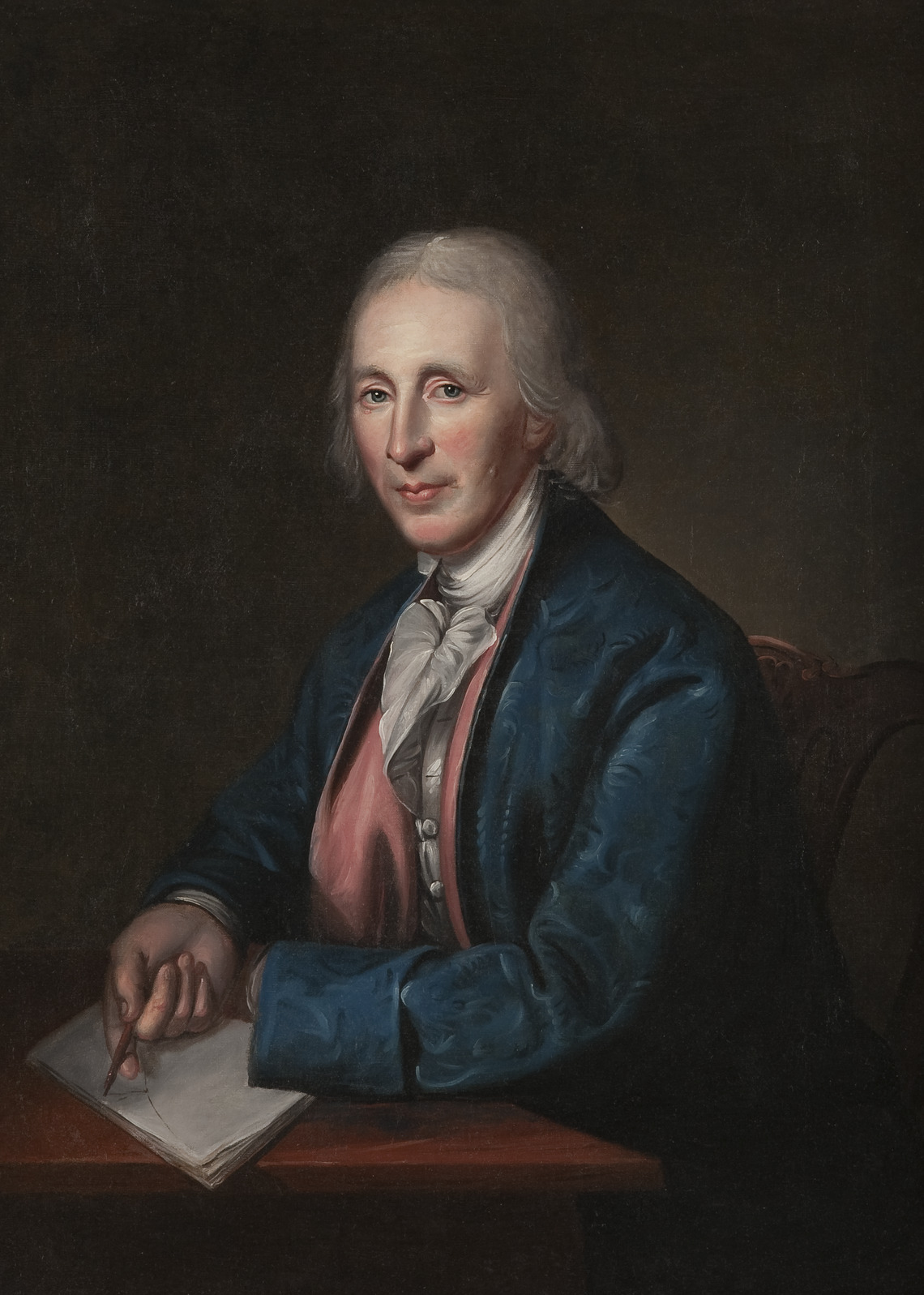
David Rittenhouse in a portrait by Charles Willson Peale (1791).
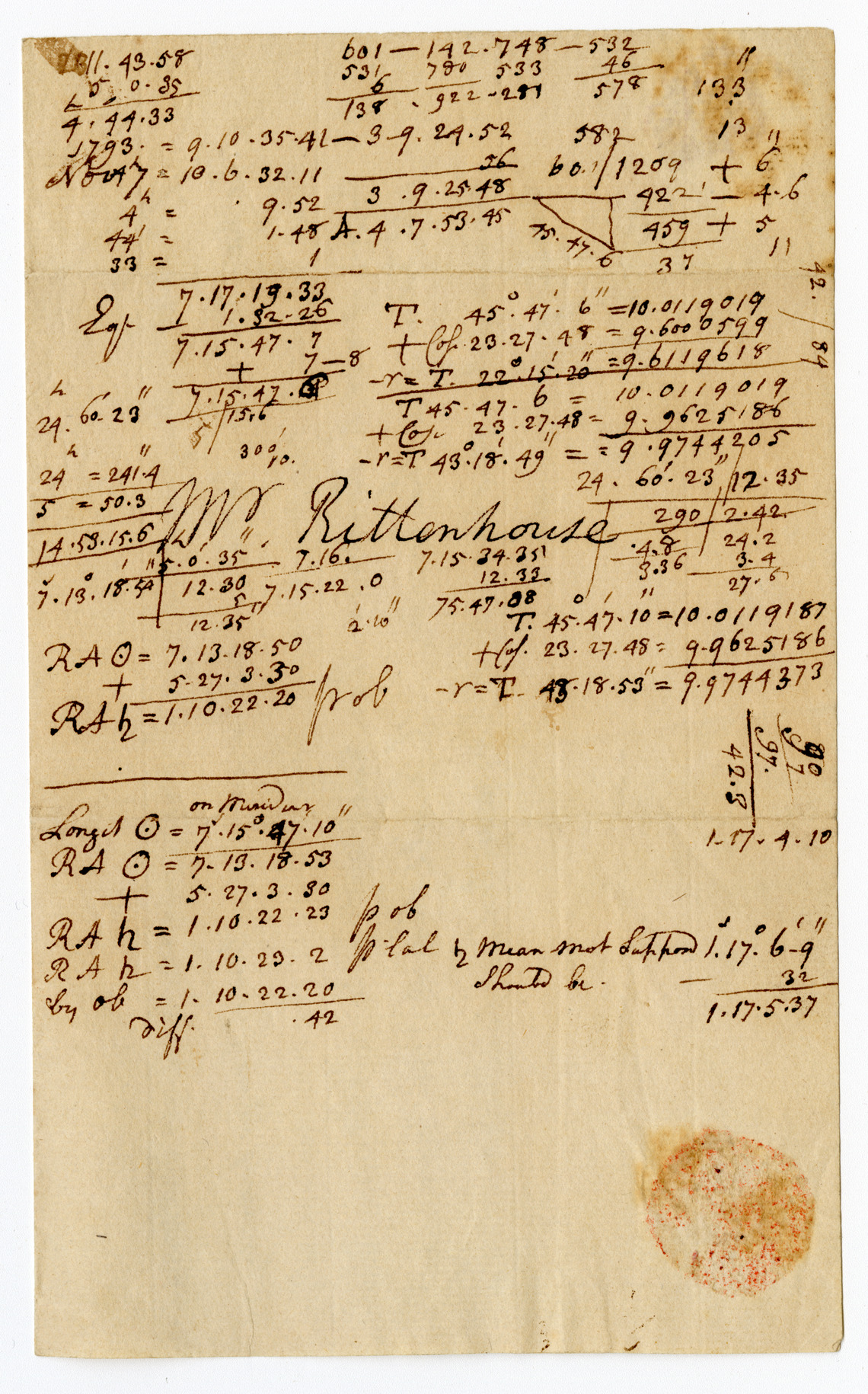
Letter from Thomas Jefferson to David Rittenhouse, written on September 6, 1793, while both were living in Philadelphia. The letter asks whether Jefferson’s daughters could use Rittenhouse’s camera obscura and includes rough calculations. From the Sol Feinstone Papers.
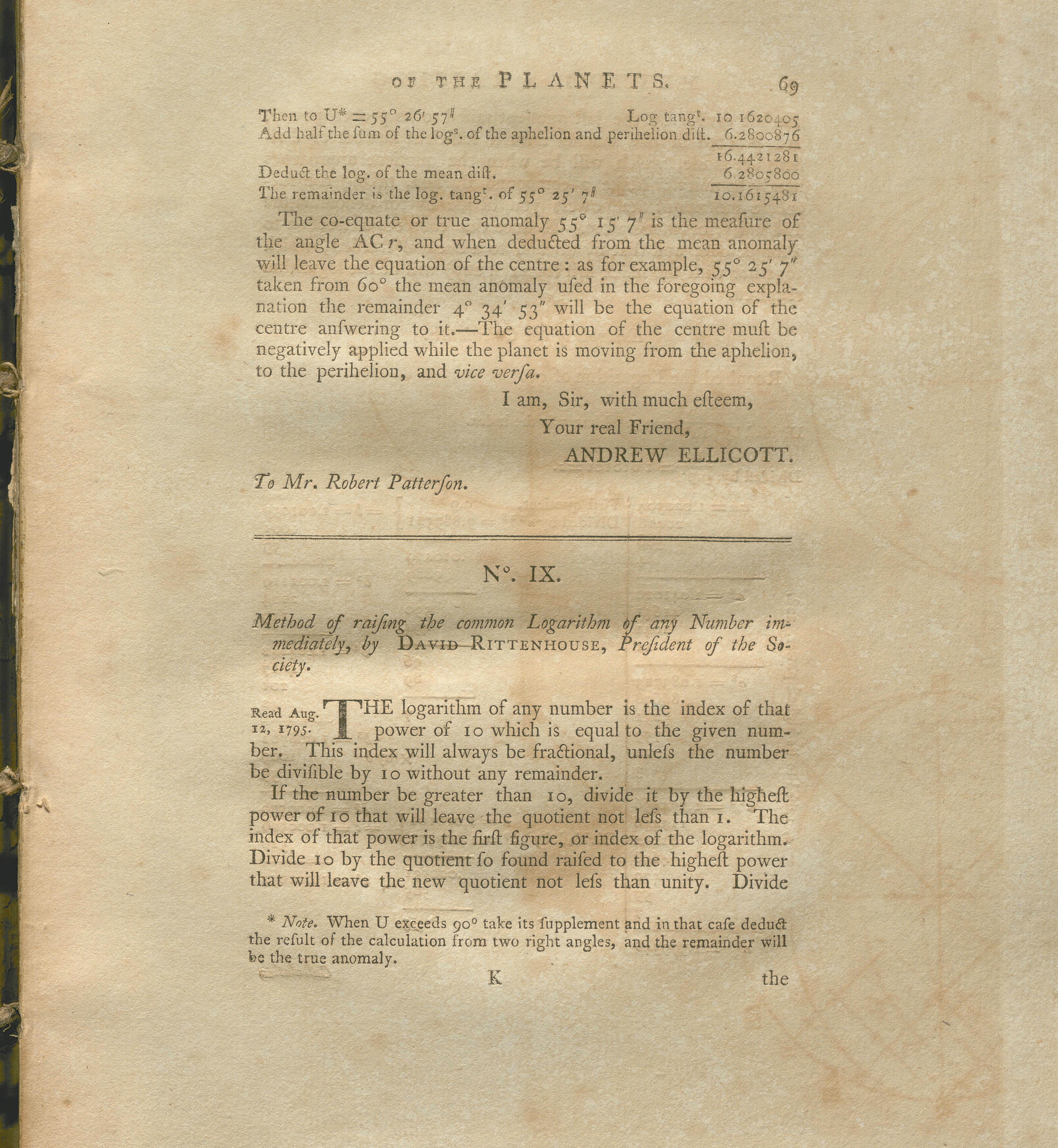
Rittenhouse’s mathematical paper, “Method of Raising the Common Logarithm of Any Number Immediately,” Transactions of the American Philosophical Society 4 (1799), 69-71.

Astronomical predictions from January 1777 of David Rittenhouse’s The Universal Almanack, for the Year of Our Lord 1777 (Philadelphia: James Humphreys, Jun., 1777).
Further reading:
- Alexander, Marion W. “What Mathematics Rittenhouse Knew.” In Research in History and Philosophy of Mathematics, edited by Maria Zack and Dirk Schlimm, 69–89. Cham: Springer International Publishing AG, 2018.
- Alexander, Marion W. “The Mathematical Complement of David Rittenhouse.” Proceedings of the American Philosophical Society 165, no. 3–4 (2004): 107–39.
- Barton, William. Memoirs of the Life of David Rittenhouse, LLD. F.R.S.: Late President of the American Philosophical Society, &c. Interspersed with Various Notices of Many Distinguished Men: With an Appendix, Containing Sundry Philosophical and Other Papers, Most of Which Have Not Hitherto Been Published. Philadelphia: Edward Parker, 1813.