A Changing Mathematical Landscape: 1900 to World War II
As new models of higher education took root prior to the United States’ entry into World War I in 1917, more universities were founded with or embraced the research ethos. This point of view extended to their mathematicians. The University of Chicago, opened in 1892, quickly eclipsed Johns Hopkins as America’s leader in mathematical research. Among the colonial colleges, Harvard and Princeton saw the writing on the wall and made significant moves to build their programs in mathematics. The Massachusetts Institute of Technology, the land grant school in Massachusetts, did the same, as did other land grants nationwide, like the University of California in Berkeley. Another new model, the privately-funded, purely post-graduate Institute for Advanced Study, was realized in Princeton beginning in 1930.
Concurrent with these developments, the American Mathematical Society (AMS), founded as the New York Mathematical Society in 1888, grew to serve the professional needs of the growing body of mathematical researchers through its regular meetings as well as its publications. Since most mathematicians also taught, it was natural that another organization, the Mathematical Association of America, emerged (in 1915) to nurture that aspect of the life of the professional mathematician.
With this infrastructure supporting research-oriented programs from coast to coast by the 1930s, the United States was poised to absorb many of the mathematicians who were forced to flee Europe by the geopolitical storms that rocked it. Bryn Mawr College in Pennsylvania, the only one of the women’s colleges to support a graduate program, hired German algebraist Emmy Noether. New York University became a major focal point for applied mathematics after it welcomed Göttingen University’s Richard Courant to its faculty. The list goes on. Shoulder to shoulder with first-rate American mathematicians, these newcomers worked to advance the frontiers of mathematics in fields both pure and applied. There was a growing sense, as Roland Richardson, Secretary of the AMS put it in 1939, that “the center of gravity of mathematics has moved more definitely toward America.”
The persecution of Jewish academics by the Nazi regime in Germany caused a dramatic change in American mathematics. Over one hundred Jewish mathematicians, including some of the field’s leading minds, emigrated to the United States at this time. They established themselves at colleges and universities from coast to coast. One of the very best, algebraist Emmy Noether (1882–1935), joined the Department of Mathematics at Bryn Mawr College in 1933. She was renowned as one of the guiding lights behind what would become modern algebra. Sadly, she died in 1935 following complications from surgery.

Emmy Noether in a photograph from around 1930. Attributed to Hennig Nolte, it was reproduced in Hermann Weyl and Albert Einstein, In Memory of Emmy Noether, Visiting Professor of Mathematics, Bryn Mawr College, 1922—April 1935 (undated).

Following Noether’s death, a committee, listed in this document, was formed to establish a Noether Memorial at Bryn Mawr College. From the Florence Sabin Papers, Box 32, Folder 1.

Fund-raising solicitation letter for the Noether Memorial Fund from Florence Sabin, noted physician and the first woman to be elected to the National Academy of Sciences, to Bryn Mawr alumna Dorothy S. Backer. From the Florence Sabin Papers, Box 32, Folder 2.

Letter to the Editor of The New York Times from Albert Einstein, May 4, 1935, in reaction to Noether’s death. From the Florence Sabin Papers, Box 32, Folder 4.
Further reading:
- Rowe, David E. Emmy Noether - Mathematician Extraordinaire. Cham: Springer, 2021.
- Siegmund-Schultze, Reinhard. Mathematicians Fleeing from Nazi Germany: Individual Fates and Global Impact. Princeton: Princeton University Press, 2009.
American mathematical research flourished in the years leading up to World War II. Great strides were made in the broad areas of topology, geometry, algebra, and analysis. Other, newer specialties like symbolic logic also emerged. The research university became the central hub for advancing mathematical research. Although the Johns Hopkins University—followed quickly by the University of Chicago and Harvard—led in the process of this development, Princeton University joined them after 1900 and would eventually support one of the nation’s strongest departments of mathematics.
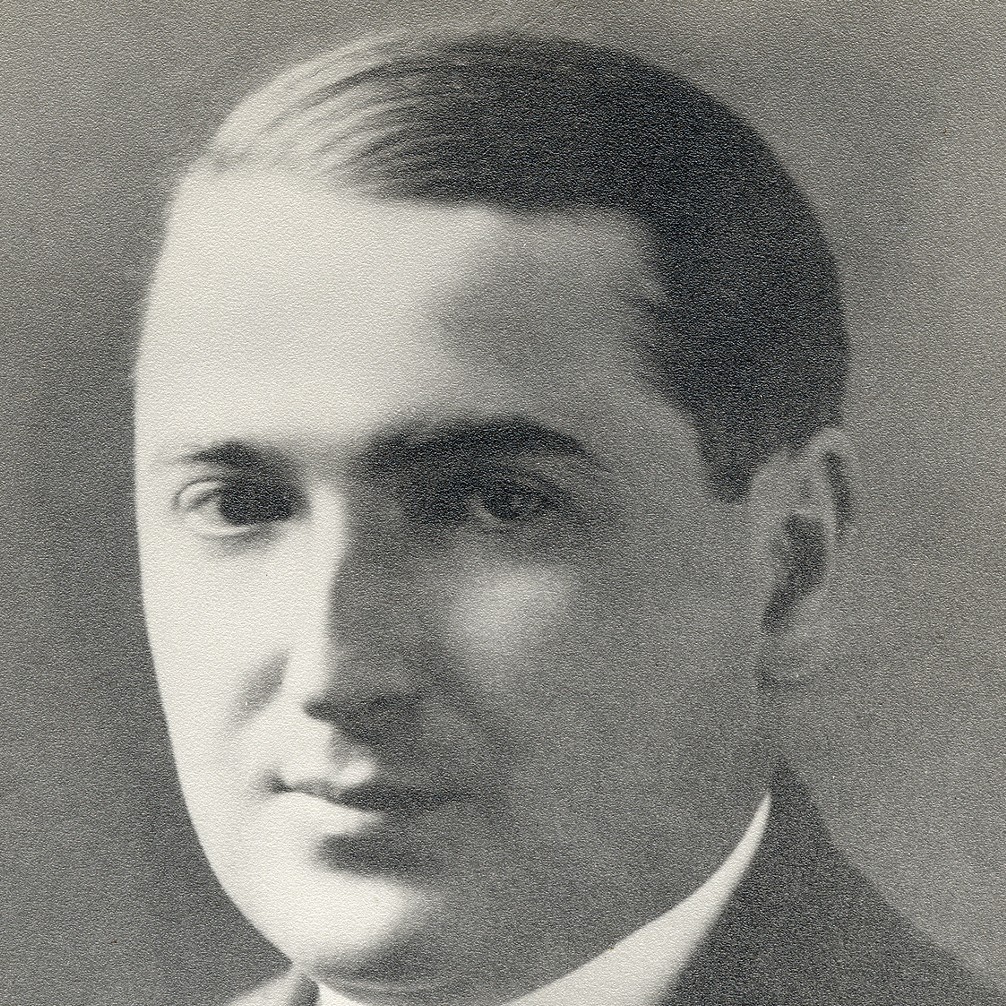
Photograph of Emil Post (1897–1954) dated June 1924. Post was an American leader in symbolic logic most noted for his work in recursion theory. From the Post Papers, Box 8.

The first two pages of this typescript from 1936 describe the so-called “Post machine,” a mathematical model of computation that he developed independently of and at essentially the same time that Alan Turing developed his Turing machine.

Members of the Princeton Department of Mathematics (early 1950s). From left to right: (first row) Albert Tucker, Emil Artin, Solomon Lefschetz, Alonzo Church, William Feller; (second row) Samuel Wilks, John Tukey, Donald Spencer, ??, Valentine Bargemann. From the Tukey Papers, Box 1.
Further reading:
- Parshall, Karen Hunger. The New Era in American Mathematics, 1920-1950. Princeton: Princeton University Press, 2022.
- Stillwell, John. “Emil Post and His Anticipation of Gödel and Turing.” Mathematics Magazine 77, no. 1 (2004): 3–14. https://doi.org/10.1080/0025570X.2004.11953222.