Mathematics in the New Republic to 1900
Following victory over the British in the Revolutionary War in 1783, the newly founded United States embarked on a process of structure-building that fundamentally involved education at all levels. Having taken their curricular lead from Great Britain before the war, mathematicians at American colleges continued to import British mathematics texts for their classrooms. They also began to bring out American editions of those works that catered more to their audience and to compile compendia of the “best of” British works.
By the 1820s, however, mathematicians in the United States as well as some in Britain, came to recognize the superiority of French mathematical techniques and approaches. At Harvard, for example, John Farrar, the fifth Hollis Professor of Mathematicks and Natural Philosophy, translated several key French texts—in geometry, trigonometry both plane and spherical, and algebra—for the use of his students. More importantly, he and his colleague George Emerson based their 1824 text, First Principles of Differential and Integral Calculus, on the mathematical course that French mathematician Étienne Bézout had developed over the closing decades of the eighteenth century. In so doing, they introduced the approach to the calculus championed by Gottfried Leibniz (essentially the version we still use today) as opposed to that developed by Isaac Newton.
This redirection of the mathematics curriculum coincided with the development of more specialized instruction in mathematics and the sciences. For example, at Harvard the Lawrence Scientific School was founded in 1847 with Benjamin Peirce as a member of its faculty, while at Yale the Sheffield School opened in 1861 and awarded America’s first Ph.D. in engineering to Josiah Willard Gibbs in 1863. Following his American training, moreover, Gibbs, like so many others in the decades around 1900, proceeded to Germany for post-graduate work. He thus embodied the third major nineteenth-century, international, mathematical influence on the United States.
By the century’s closing quarter, the Land Grant Act of 1862 had resulted in the establishment of new universities in each state with an emphasis on mathematics and the applied sciences. The country’s first research university, the Johns Hopkins University, had also been founded in Baltimore, Maryland, largely on the German model. From this point forward, mathematical research, as opposed to simply the teaching of mathematical content, became an integral part of the American mathematical landscape.
From 1776 to 1876, mathematics developed in the United States not as a specialty but as a part of American science. The lives and work of Nathaniel Bowditch (1773–1838) and Benjamin Peirce (1809–1880) exemplify this. The largely self-taught Bowditch, who made his living as an actuary, did fundamental work in mathematics, navigation, and astronomy. His translation of Pierre Simon de Laplace’s Mécanique céleste was ground-breaking and included extensive mathematical commentary. Peirce, on the other hand, was a Harvard-educated professor. He pursued research in both pure and applied mathematics during the final quarter of the nineteenth century.

Nathaniel Bowditch, portrayed in an engraving engraved by J. Gross and drawn by J. B. Longacre (undated).
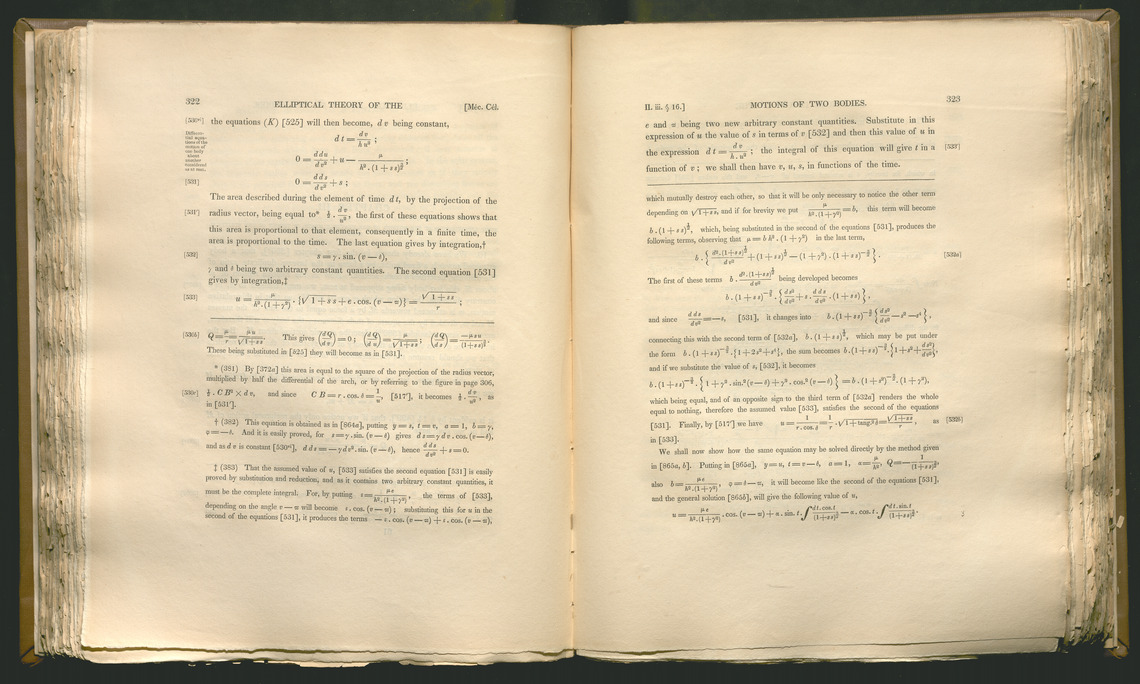
Pages 322–323 of Bowditch’s translation of the Mécanique céleste showing an example of one of the extensive, explanatory mathematical footnotes that he added to Laplace’s notoriously terse and complex text.
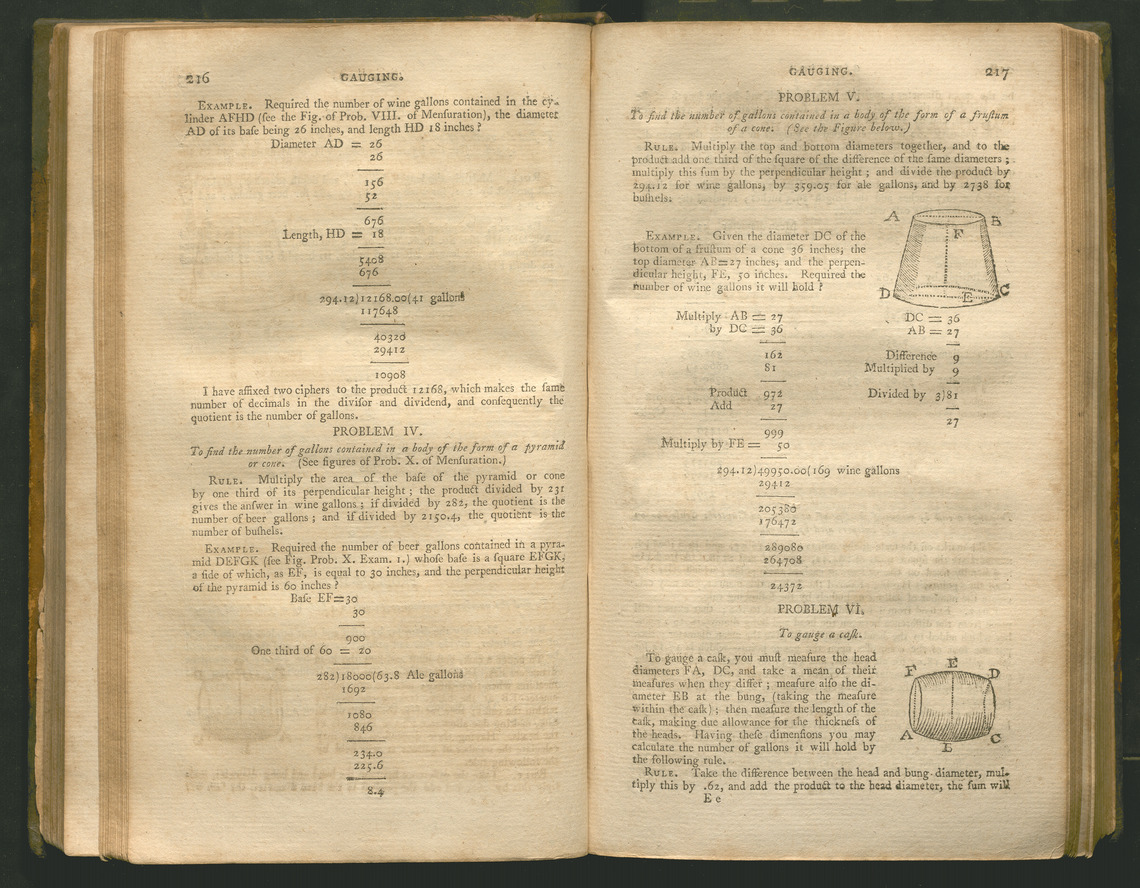
On gauging, that is, calculating the number of gallons, bushels, etc., a container of calculated volume will hold. From Bowditch’s The New American Practical Navigator.

Reproduction of a daguerreotype of Benjamin Peirce (ca. 1845). Reproduced in Raymond Clare Archibald, Benjamin Peirce 1809—1880: Biographical Sketch and Bibliography (Oberlin, OH: The Mathematical Association of America, 1925).
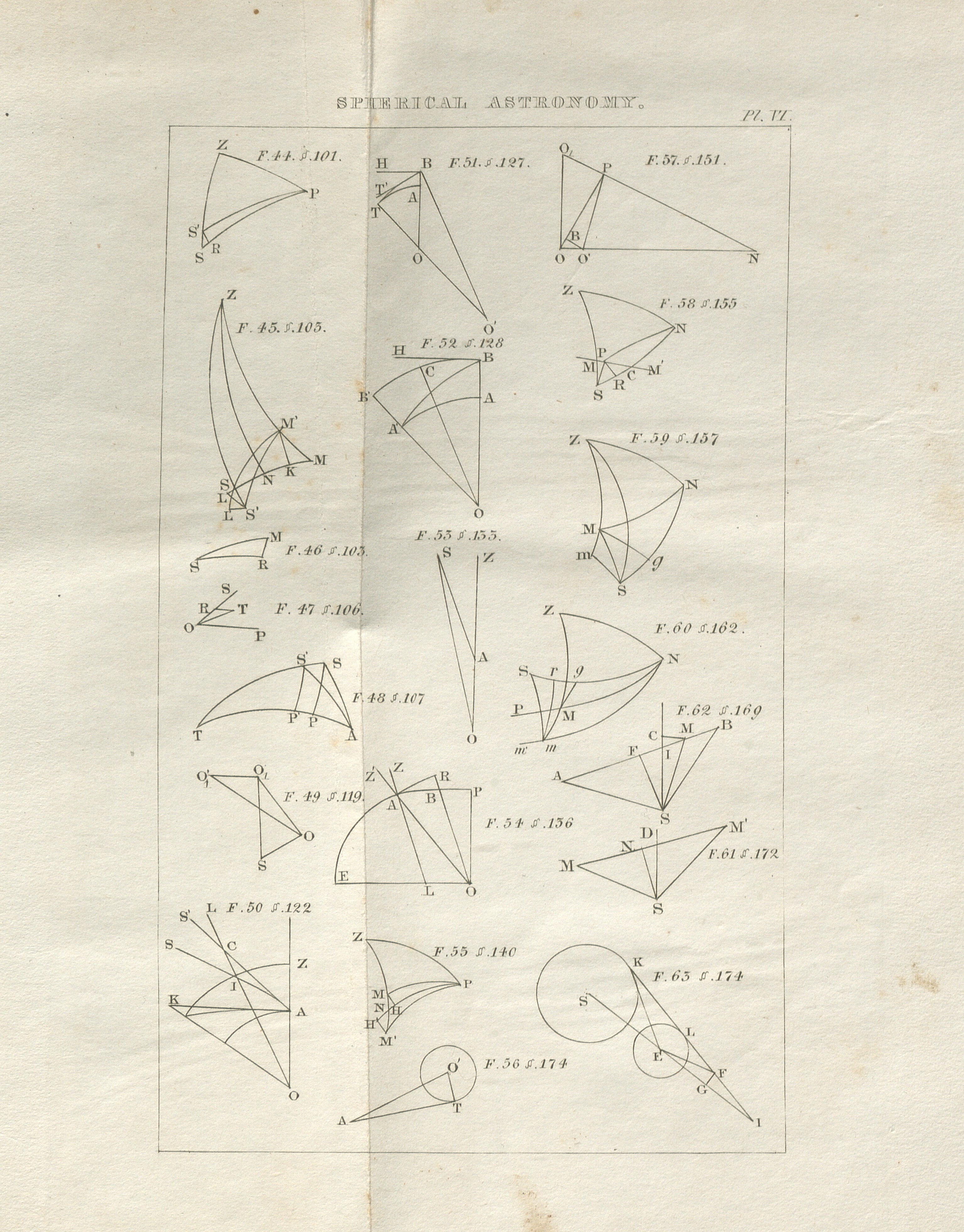
The pullout on spherical trigonometry from Benjamin Peirce’s book, An Elementary Treatise on Plane and Spherical Trigonometry with Their Applications to Navigation, Surveying, Heights & Distances, and Spherical Astronomy (Boston: James Munroe and Company, 1840).
Further reading:
- Hogan, Edward R. Of the Human Heart: A Biography of Benjamin Peirce. Bethlehem, PA: Lehigh University Press, 2008.
- Thornton, Tamara Plakins. Nathaniel Bowditch and the Power of Numbers: How a Nineteenth-Century Man of Business, Science, and the Sea Changed American Life. Raleigh: University of North Carolina Press, 2016.
A community of mathematical researchers developed in the United States during the last quarter of the nineteenth century. Key to that process was the Johns Hopkins University, founded in 1876 as the nation’s first research university. Its first professor of mathematics was the English algebraist James Joseph Sylvester (1814–1897), who developed an innovative program for graduate research centered on research seminars and with an emphasis on the publication of original research. Other colleges soon followed this example. At Yale, for example, Josiah Willard Gibbs (1839–1903) pursued original research in mathematics, chemistry, and thermodynamics.
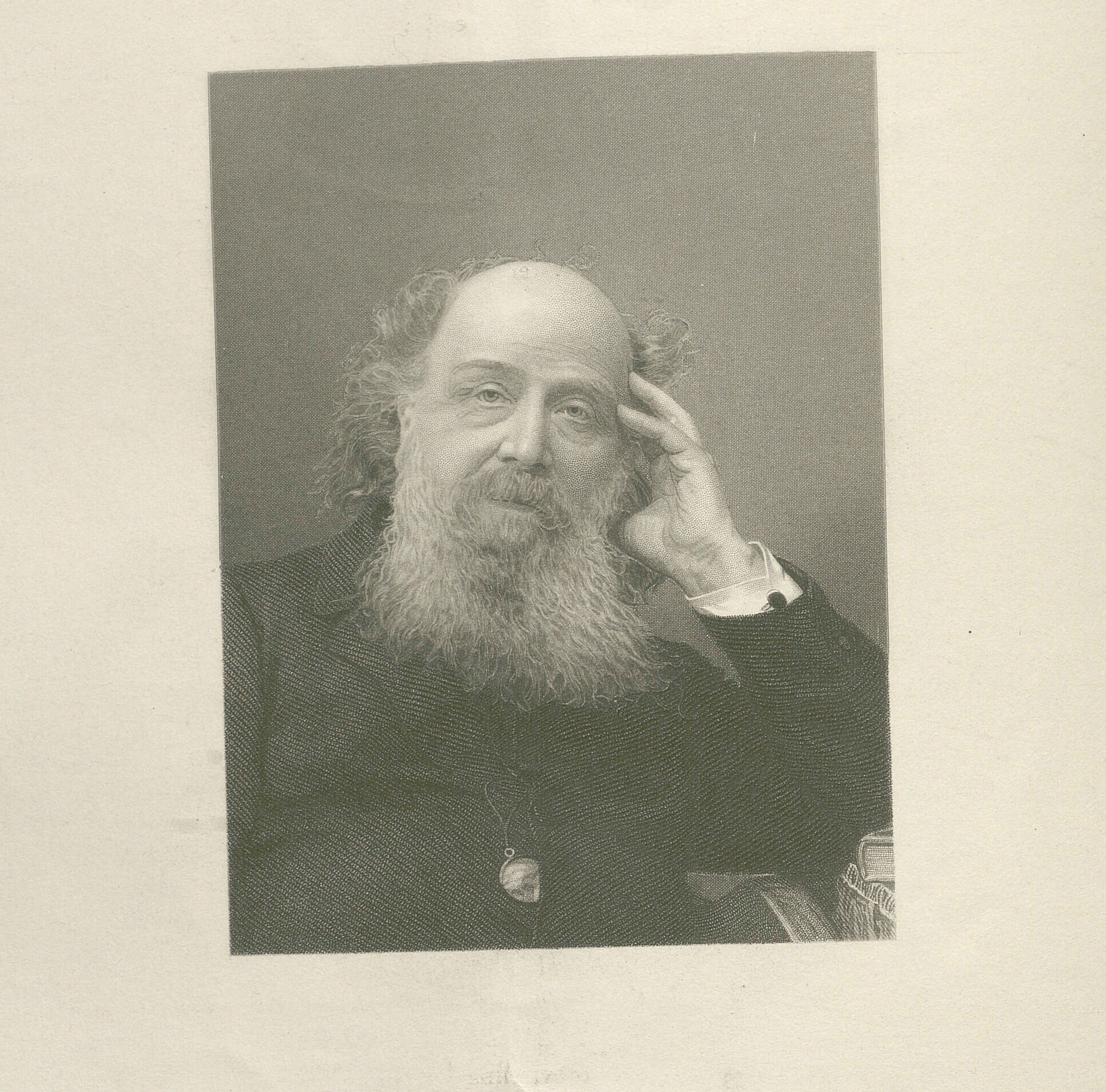
James Joseph Sylvester, in an engraving performed by G. J. Stodart after a photograph by the photography studio J. Stilliard & Co. The image was reproduced in the January 3, 1889 issue of Nature to accompany an article celebrating Sylvester's scientific achievements.
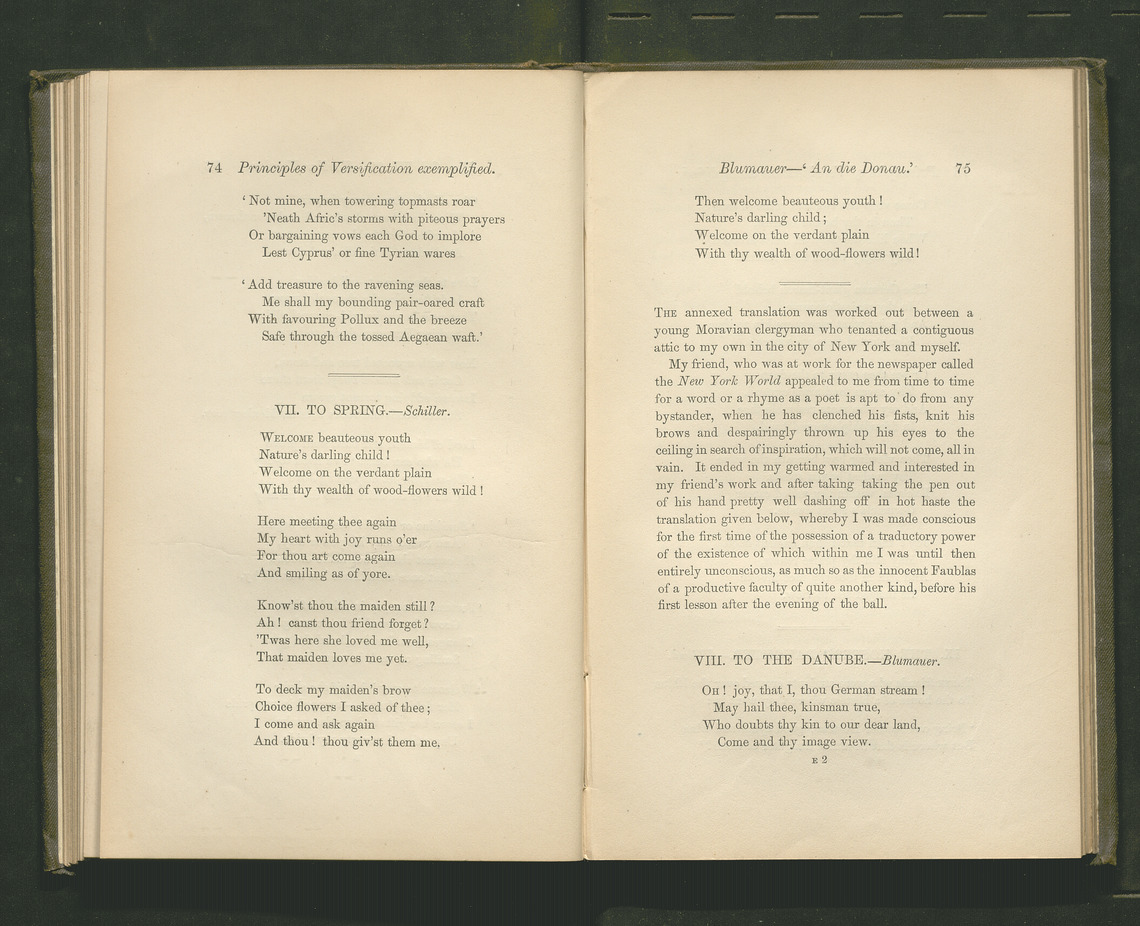
Sylvester’s translation of Friedrich Schiller’s “To Spring” using his pseudomathematical “laws of verse.” Note the annotation which is so typical of Sylvester’s writing.
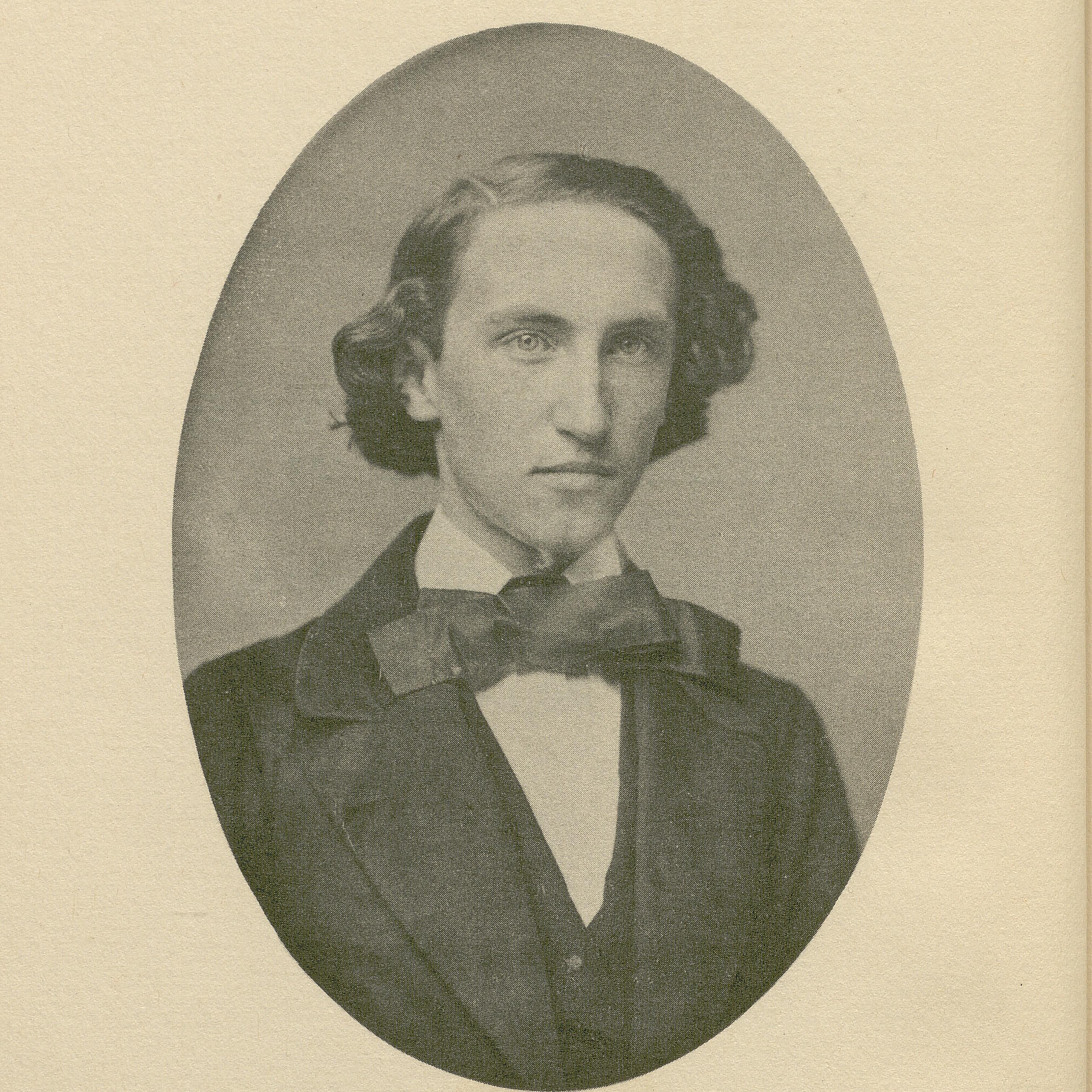
Daguerrotype taken of Josiah Willard Gibbs during his student days at Yale. From Lynde Wheeler, Everett Oyler Waters, and Samuel William Dudley, ed., The Early Work of Willard Gibbs in Applied Mechanics; comprising the text of his hitherto unpublished Ph.D. thesis and accounts of his mechanical inventions (New York: Henry Shuman, 1947).
Further reading:
- Parshall, Karen Hunger. James Joseph Sylvester: Jewish Mathematician in a Victorian World. Baltimore: Johns Hopkins University Press, 2006.
- Parshall, Karen Hunger. James Joseph Sylvester: Life and Work in Letters. Oxford: Clarendon Press, 1998.
- Parshall, Karen Hunger, and David E. Rowe. The Emergence of the American Mathematical Research Community, 1876-1900: J. J. Sylvester, Felix Klein and E. H. Moore. History of Mathematics 8. Providence (R.I.) and London: American Mathematical Society and London Mathematical Society, 1994.