American Mathematics Around World War II
The outbreak of World War II in Europe in 1939 forced the cancellation of plans for what would have been, in 1940, the first International Congress of Mathematicians (ICM) to have been hosted by the United States. In the eyes of its organizers, it would have made manifest to the rest of the mathematical world the great strides that had taken place in research mathematics in the United States. It would have shown mathematical America to be a peer, and no longer a student, of mathematical Europe.
The exigencies of this second world war, especially after the United States’ entry into it in 1941, however, found American mathematicians focused on very different matters. What would its mobilization for the war effort look like? How could it assert itself effectively in what was clearly a fast-growing scientific bureaucracy? Answers to both questions quickly took shape.
Intensive “crash courses” would be needed, especially for servicemen engaged in ballistics and navigation. The armed forces would need higher level expertise for technical mathematical problem-solving. In particular, Polish emigré and University of Wisconsin mathematician, Stanislaw Ulam, and Hungarian emigré and member of the faculty of mathematics at the Institute for Advanced Study in Princeton, John von Neumann, were actively engaged in the top-secret development of the atomic bomb. To aid in this and other work that involved massive calculation, von Neumann—together with other mathematicians like Herman Goldstine—collaborated with physicists and engineers to create the first programmable computers. This new research was supported by a massive influx of funds from the Federal government specifically in support of the sciences, including mathematics. Such external funding, as well as the bureaucracies associated with it, represented a lasting impact of the war.
After the war, as America’s mathematicians reestablished their academic and research rhythms, they also worked to realize the plans for the first ICM in the United States that had been so abruptly put on hold in 1939. Some, like John Kline, Richardson’s successor as AMS Secretary, believed that the United States had actually “assumed world leadership in mathematics” and that the ICM it finally hosted in 1950 represented the telling moment.
The American mathematical community began mobilizing for war well before the United States entered World War II in December 1941. Mathematicians fashioned new programs in applied mathematics essential for improving the effectiveness of American industries. They also developed and taught courses instructing members of the armed services in the mathematical basics of navigation and ballistics. As active partners in the creation of both the atomic bomb and the first electronic computers, they fundamentally shaped the post-World-War-II era.

President John F. Kennedy shaking hands with Stanislaw Ulam. Ulam, a Polish-Jewish emigré, had secured a job at the University of Wisconsin in Madison before becoming a key member of the group working on the atomic bomb at Los Alamos. From the Ulam Papers, Series XIII, Box 1.

The Trinity (Alamogordo) atomic bomb test, July 16, 1945. From the Ulam Papers, Series XIII, Box 1.

Security handbook issued to members of the Los Alamos team of scientists. From the Ulam Papers, Series XII-2.

Ulam’s handwritten draft of his paper “On the Monte Carlo Method.” This method was first conceived at Los Alamos in 1946. It was initially used to calculate neutron diffusion paths for the hydrogen bomb. It hinges on repeated random sampling to solve complex problems. From the Ulam Papers, Series IX, Box 7.
Further reading:
- Parshall, Karen Hunger. The New Era in American Mathematics, 1920-1950. Princeton: Princeton University Press, 2022.
- Ulam, Stanislaw. Adventures of a Mathematician. New York: Charles Scribner’s Sons, 1976.
ENIAC (Electronic Numerical Integrator and Computer), the first programmable, general purpose digital computer, was developed at the very end of World War II. This federally funded war-related initiative was a collaboration between the Ballistic Research Laboratory at the Aberdeen Proving Ground in Maryland and the University of Pennsylvania. It engaged many mathematical minds, among them, Herman Goldstine and John von Neumann. Funding for the development of electronic computers continued to flow after the war through the Office of Naval Research. Mathematician Mina Rees was tapped from her wartime post in the Applied Mathematics Panel to head the Mathematics Branch.

American mathematician, Mina Rees (1902–1997), was instrumental during and immediately after World War II in allocating Federal funding for basic scientific research. The examples she set informed the National Science Foundation after its founding in 1950. From the Piore Papers, Series V, Box 5.

Photograph of the Electronic Numerical Integrator and Computer (ENIAC), the first programmable, general purpose digital computer. From the Ulam Papers, Series XIII, Box 1.

Two-page letter from Mina Rees to Herman Goldstine dated June 2, 1947. This letter shows how engaged Rees was with the scientific projects she was asked to fund.

Two-page reply from Goldstine to Rees dated July 2, 1947. This letter demonstrates a collaborative relationship between scientist and funder. From the Goldstine Papers, Series I, Box 6.
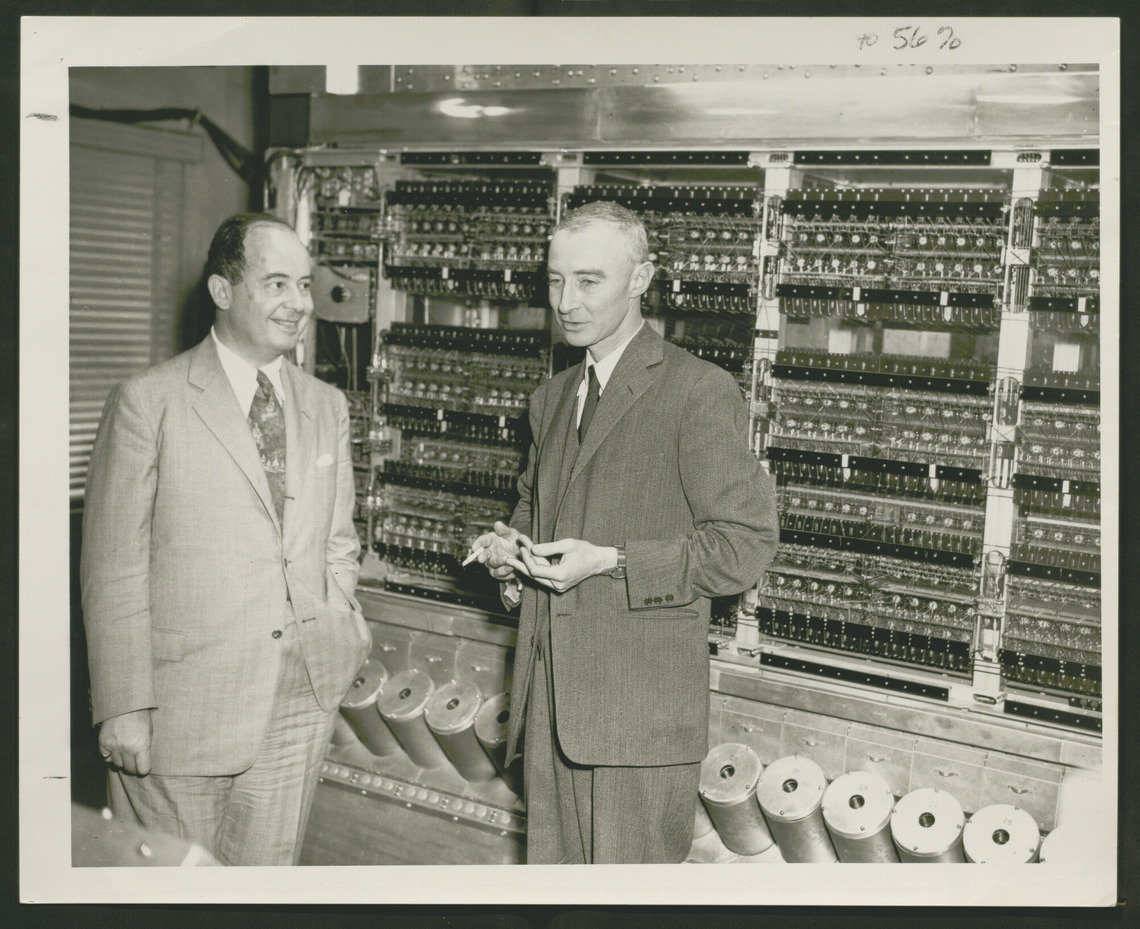
Photograph of Robert Oppenheimer (on the right) and John von Neumann standing in front of the “rival” computing machine. This machine was developed at the Institute for Advanced Study in Princeton. From the Goldstine Papers, Series IV, Box 69.
Further reading:
- Goldstine, Herman. The Computer from Pascal to von Neumann. Princeton: Princeton University Press, 1980.
- Parshall, Karen Hunger. The New Era in American Mathematics, 1920-1950. Princeton: Princeton University Press, 2022.
- Shell-Gellasch, Amy. In Service to Mathematics: The Life and Work of Mina Rees. Boston: Docent Press, 2001.